Digital
Twins.
Energy, food and manufacturing are running on instrumentation that doesn't yet think.
- 01Sensors have outrun decisions.The bottleneck has moved from data capture to data-grounded action.
- 02Regulators are pulling forward.GMP, FSMA, NIST AI RMF, custody-transfer codes — every compliant industry now wants traceable, simulatable proof of work.
- 03Capital cycles are compressing.Brownfield retrofits and greenfield builds need to be commissioned, optimised, and audited at the same time.
- 04The technology is finally ready.Real-time physics, supervisory AI, and compliant workflow rails are shippable to the plant floor today.
Most "digital twins" today are pictures of plants. They don't simulate, govern, or gate the work.
- 01Visualisation without simulation.A pretty 3D scene that can't predict the next batch, campaign, or deviation.
- 02Sensors without supervision.Tags captured, charted, and ignored.
- 03SOPs without enforcement.Compliance lives in PDFs; the work happens in spreadsheets.
- 04Pilots that never industrialise.Six-figure POCs that don't survive contact with operations.
Every batch, every kilometre, every release without a twin is uncalibrated risk.
traceable to events the operator never saw in time.
typical lag from a process insight to a hardened operating procedure.
when the twin gates the work — not just describes it.
What we build.
One discipline. Three twin shapes that span the work.
- 01Physics twins.Real-time, event-driven simulation calibrated to plant data — bioprocess, fluid, thermal, electrochemical.
- 02Asset twins.Pipeline, vessel, and line-level mirrors of operating state, instrumented for live decision support.
- 03Process twins.Compliant workflow rails that capture how the work is allowed to happen — and gate it accordingly.
- 04Shared substrate.Every twin runs against versioned schemas, harvests from the same sensor and document layer, and ships with full audit trails.
Mirror. Govern. Forecast.
MIRROR
- Live state of the assetin the physics units operators trust.
- Sensor noise, drift, failuremodelled — not hidden.
- Every readingcarries provenance and confidence.
GOVERN
- The work is constrainedto compliant paths.
- The twin knowswhat is and isn't allowed at this moment.
- Spec, permit, or release breachesare blocked before the action — not after.
FORECAST
- Run the next hour, batch, campaign forward.
- Inject disturbancestest interventions, rehearse failure.
- Choose the operating pointwith the least downstream risk.
Six capabilities that compose into any plant twin.
Real-time simulation engine
Event loop, deterministic, calibrated to source data — runs at the rate of the real plant.
Sensor & disturbance models
Noise, drift, failure — faults you can rehearse, not just observe.
Process recipes & scenarios
Bioprocesses, pipeline regimes, compliant QC sequences — versioned and runnable.
3D scene + operator dashboard
Babylon.js plant view, panels, alerts, trend charts, replay — what the shift sees.
Schema-bound compliance
Workflows hardened as data; gates expressible, auditable, and refusable.
Supervisory AI layer
Claude-grade reasoning over plant context — drafts reports, watches anomalies, surfaces next actions.
A shift with the twin looks nothing like a shift without one.
Before / after, in the rhythm of an actual workday. The twin compresses the gap between knowing what's happening and deciding what to do.
Pre-shift brief
Last 24 hours, deviations, open holds, watch items — all in one frame.
Sensor drift on Vat 3
Model flags before the spec is breached; deviation is logged, SOP linked, note drafted.
New campaign scenario
Run the next 8 hours forward against three recipe variants — pick the tightest yield distribution.
Release gate
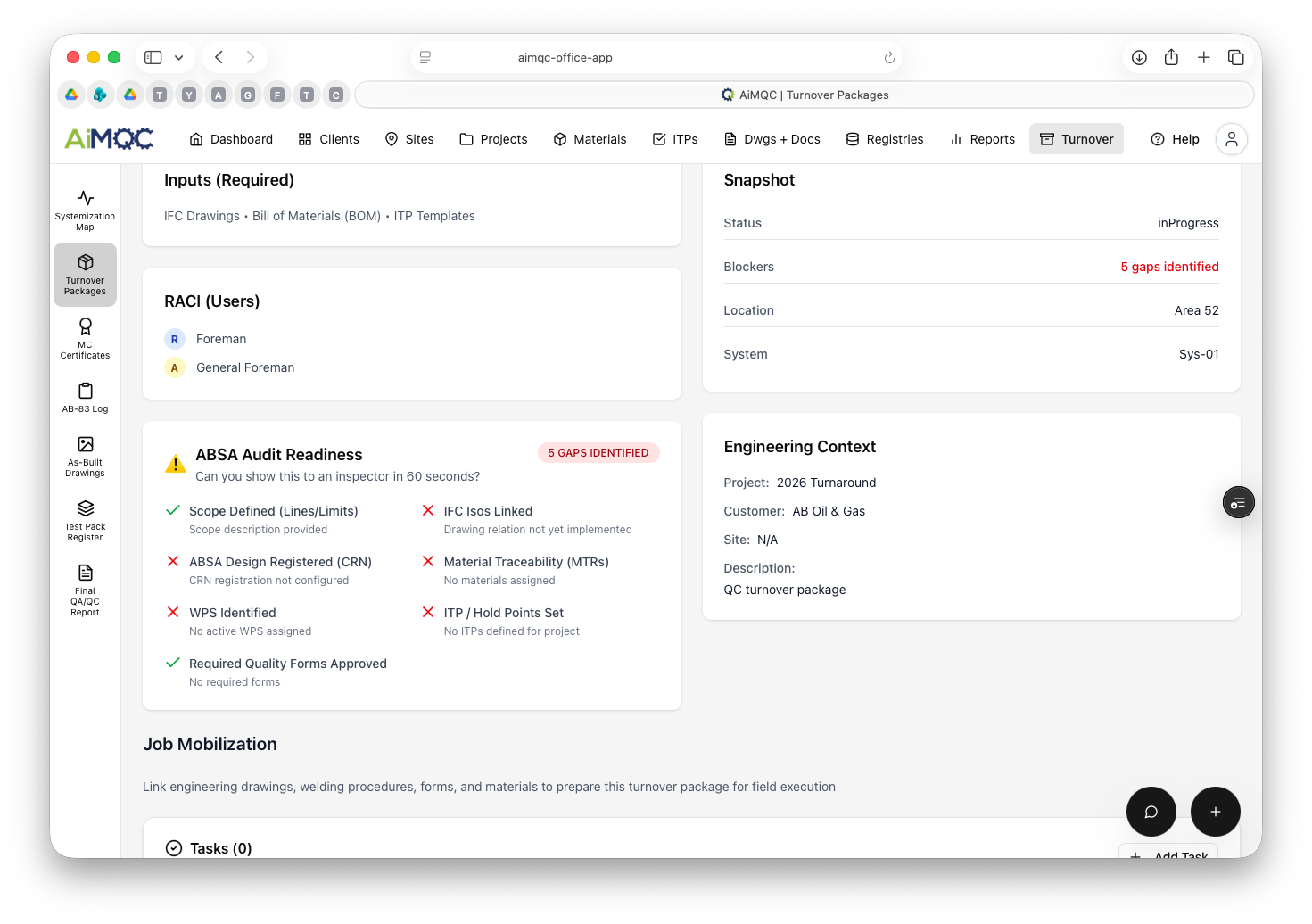
AiMQC: are all conditions met? If not, exactly what's missing — and what is missing it.
The twins.
On the plant. On the network you trust. Auditable from the first commit.
- 01On-premise where it needs to beclose to the line, no cloud round-trip.
- 02Local inference for sensitive workClaude API for depth, speed, and 24/7 supervision.
- 03Versioned, diffable, auditableevery twin runs against YAML schemas under source control.
- 04Encrypted at rest and in transitbackup and restore built in.
- 05Portablethe twin runs in a Claude session, a Next.js dashboard, or a Babylon.js plant view — same data underneath.
Food, energy, manufacturing — three projects, three twin shapes, all live in 2026.
fermentDT
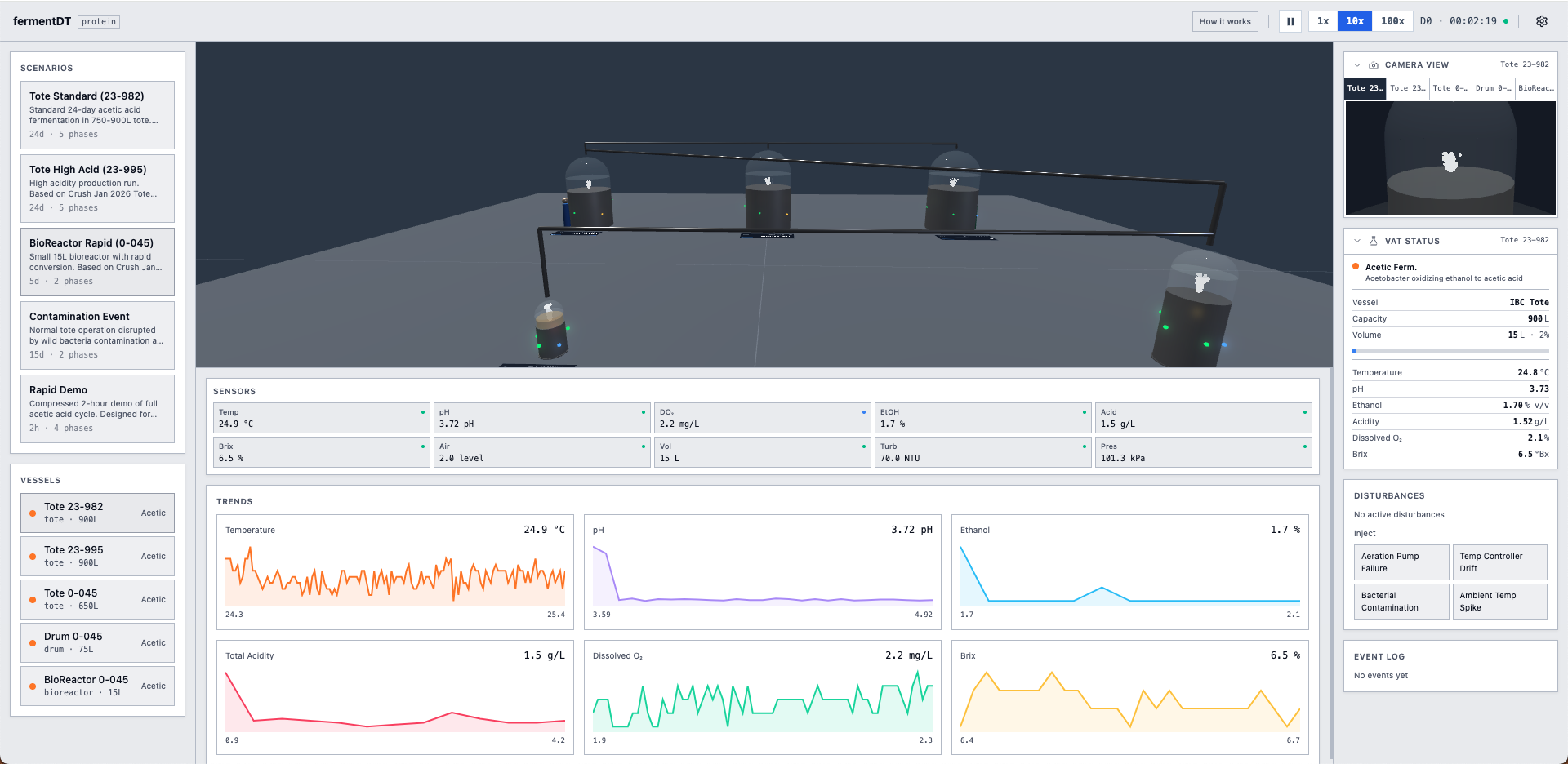
- Physics twin of industrial fermentationcalibrated to real plant data.
- Real-time bioprocess simulationMonod kinetics, substrate-to-product conversion, biomass dynamics, environment, sensor models with noise, drift, failure.
- Babylon.js 3D scene + operator dashboardscenarios + disturbance injection for operator training and recipe optimisation.
Pipeline Networking
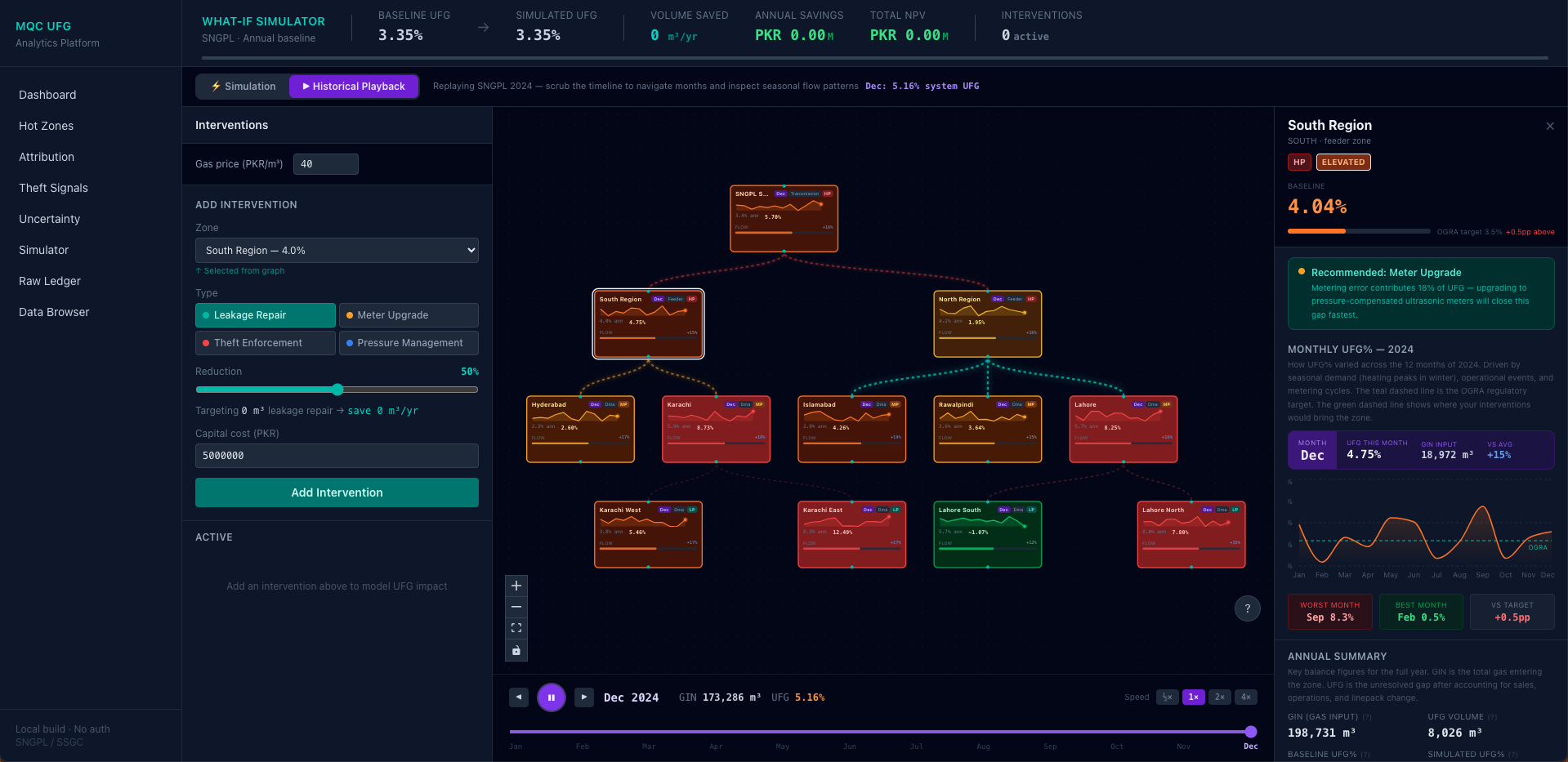
- Asset twin of pipeline operationsflow regimes, quality, and metering mirrored in real time.
- Measurement quality surfaced — not hiddenuncertainty, drift, and regime breaks visible to the operator.
- Compliance posture for custody transferread directly off the twin, not assembled from logs after the fact.
AiMQC
- Process twin of in-situ QCexisting operations captured in versioned schema, hardened into compliant workflows.
- The app constrains work to compliant pathsand refuses what isn't allowed — by design, not by reminder.
- Simulation moderehearse the conditions in which work will and won't proceed before they hit the floor.
A working twin, wired into your plant, with the team that built it on the line.
- 01Calibrate to your data.We mirror your sensors, your SOPs, your recipes. The twin reflects your operation — not a template.
- 02Hands-on commissioning.We scaffold the schema, wire the harvesters, simulate the scenarios that matter, and stand up the dashboards alongside your team.
- 03A direct line to the team.Weekly sessions through the engagement. New capabilities ship to every partner instance.
- 04You own everything.Schema, skills, code, dashboards — yours from day one, no lock-in.
- Files, not platforms. The twin is portable YAML — diffable, version-controlled, yours.
- Physics first, polish later. Calibration to plant data precedes every visual.
- Compliance by construction. What the schema doesn't allow, the app can't do.
- You own what's built. Skills, configuration, simulations — full handover.
david@atomic47.co
Twins that ship. Twins that gate. Twins that compound.
Three live instances across food, energy, and manufacturing. One discipline. Ready to extend to your operation. Tell us what plant, what process, what would change — and we'll show you what a twin of it looks like.
A real plant, mirrored in software. Live since Q2 2026.
fermentDT — a physics-based digital twin of an industrial fermentation line. Babylon.js plant view with vats and sensor LEDs; operator dashboard with scenario library, vessel status, live sensor panel, trend charts, and an injectable disturbance kit. Calibrated to real plant data; runs deterministic 100 ms ticks.
A network, in motion. Interventions, modelled.
Pipeline Networking — an asset twin of distribution networks. Hot zones, attribution, theft and leakage signals, and a what-if simulator that scores interventions before capital is committed. Drag a meter upgrade or a leakage repair into a zone; see the network's response, the volumes saved, and the regulatory posture shift in seconds.
A release that can't go out with a condition unmet.
AiMQC — turnover packages with audit readiness baked in. Inputs, RACI, engineering context, and a live gap register show in 60 seconds whether the package is inspector-ready. The schema doesn't allow what compliance forbids — and shows exactly which gaps stand between the work and a clean release.